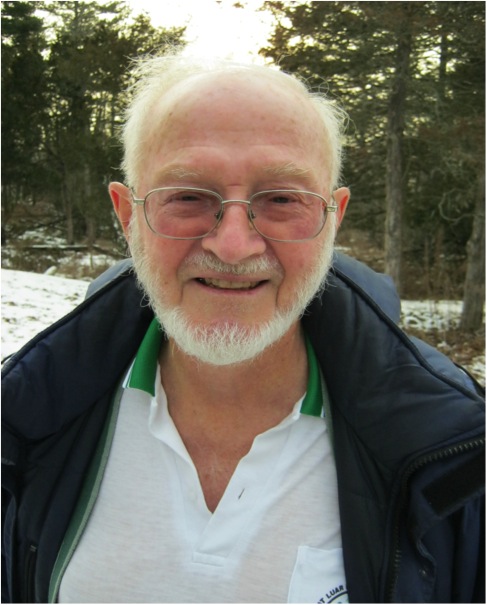
We both take great pleasure in being able to nominate Clive Goodwin for the 2014 OFO Distinguished Ornithologist Award. Clive has been a leader in Ontario field ornithology and conservation for nearly our entire lifetime and his selection as a recipient of this award is certainly well deserved.
Clive was born in Leeds, Yorkshire, England, where his earliest recollection of watching birds dates back to the age of five. By his teenage years, he had already started a birdwatching society at Castleford Grammar School in the village of Garforth, for which he received the Rotary service prize for outstanding public service upon his graduation.
After a two year conscription period in the Royal Air Force, he emigrated with his family to Toronto in 1949. He worked from 1949 to 1965 at the Canadian General Electric Company, working his way up to Production Control Manager at its electronics factory. He also completed his Bachelor of Arts degree at the University of Toronto in 1962.
Clive’s involvement in leadership roles within the Ontario natural history community was swift and it certainly blossomed into a lifelong commitment. From 1965 until 1977, he was fortunate to find a job more in keeping with his personal interests when he was appointed Executive Director of the Conservation Council of Ontario, the umbrella organization of the province’s conservation groups. His work there included the preparation and presentation of briefs to various levels of government on a wide variety of resource issues, the organization of conferences and seminars, and the editing of all council proceedings. Topics he became involved with were as diverse as wildlife management, conservation education, soil erosion, extinction, air pollution, water pollution, roads issues, and issues involving solid waste and recycling. He also edited their quarterly publication, The Bulletin.
Clive has amassed quite a prodigious output of volunteer activities on behalf of a myriad of Ontario nature clubs: On behalf of the Toronto Field Biologist Club, he served as Associate Editor of their journal, the Ontario Field Biologist, from 1957 to 1959, and served as a member of their executive committee from 1957-1959 and 1961-1964. For the Toronto Ornithological Club, he served as Business Secretary from 1956-1958 and served on their executive council from 1978-1988. From 1968 to 1982, he took over the organization of the Lake Ontario Mid-Winter Waterfowl Inventory from Ott Devitt, and went on to expand that count to include the entire Canadian shoreline of Lake Ontario. This important data set now demonstrates trends in winter waterfowl numbers in the Greater Toronto Area for an unbroken series of 69 years and the entire Canadian shore of Lake Ontario for 25 years.
For the Federation of Ontario Naturalists (FON) (now Ontario Nature), Clive served as editor of The Young Naturalist from 1959-1961, edited their magazine The Ontario Naturalist (predecessor to Seasons, now ON Nature) from 1962-1965, and wrote their ‘Worth Noting’ bird column from 1962-1967 and 1975-1982. He served as an elective board member from 1962-1966 and as an executive committee member from 1964-1965. He led FON field trips to the Bruce Peninsula for many years as well as trips to England, France and Spain. It was through the FON that Clive met his wife Joy. He also contributed the Toronto section to their 1964 A Naturalist’s Guide to Ontario and the Northumberland County section to its 1997 follow-up A Nature Guide to Ontario. Between 1968 and 1972, he served the Toronto Field Naturalists, first as Chair of the Bird Studies Group, and later as Vice-President and President.
For a truly astounding 18 years (1965-1982), Clive served as the editor of the Ontario section of Audubon Field Notes (later American Birds, now North American Birds), the journal of record for notable field observations in North America. This involved producing a quarterly four-thousand word summary of noteworthy bird observations for the whole province from a network of up to 300 observers and several dozen sub-regional editors. Anyone who has ever edited a report for a single quarter will appreciate the enormity of this accomplishment. To this very day, he still serves as a subregional editor for Northumberland County. In 1970, frustrated by the often arbitrary nature of decisions forced upon his work in Audubon Field Notes (particularly in light of the recent passing of Jim Baillie, the Royal Ontario Museum’s Assistant Curator of Ornithology), Clive was instrumental in organizing the province’s first attempt at a system of peer review of rare bird sightings by overseeing the formation of the Ontario Ornithological Records Committee and acting as its Secretary until 1982. It was the precursor to the current Ontario Bird Records Committee, which was subsequently formed along with the establishment of the Ontario Field Ornithologists in 1982, and thus extends the era of peer review of rare birds in Ontario back to an impressive period of forty-five years.
Clive has been very active in organized field work in Ontario. From 1953 to 1960 he conducted winter bird population studies that were published annually in Audubon Field Notes. Likewise, from 1955 to 1969 he conducted breeding bird population surveys that were also published in Audubon Field Notes.
Between 1950 and 2005, he had a 56 year unbroken series of participation in the annual Christmas Bird Count on either the Toronto or Cobourg counts. Similarly, he has participated in nearly every one of the 68 annual Lake Ontario Mid-Winter Waterfowl Inventory counts each January. Between 1980 and 1985, he was on the management committee for the first Ontario Breeding Bird Atlas and was a very active atlasser in several regions. From 2001 to 2005, he was a member of the local Northumberland County organizing committee for the second Ontario Breeding Bird Atlas and was an active atlasser once again.
In 1977, Clive left his position as Executive Director of the Conservation Council of Ontario to take a position as the Executive Director of Toronto’s Civic Garden Centre managing a public enterprise with 27 staff and 160 volunteers and a membership of 2600 people.
By 1981, Clive and Joy made the decision to work independently as freelance naturalists. As Clive puts it: “Very quickly we decided to offer nature courses and do nature interpretation, including leading trips. My role proved to be providing the ‘nature’ part, while Joy provided support and handled the more ‘people’ parts of the enterprise.” They began to teach bird identification courses through the Civic Garden Centre, Humber and Seneca community colleges, the Brentwood, Deer Park and Orchard-view public libraries, as well as from their home. They also hosted waterfowl viewing days for the Ontario Ministry of Natural Resources at sites like Toronto’s Humber Bay, Peel’s Rattray Marsh and Durham’s Corner Marsh. Demand dictated that they offer selected field trips to a wide variety of Ontario locations, including Point Pelee National Park, Presqu’ile Provincial Park, Long Point Provincial Park, Hilton Falls/Mountsberg Conservation Area, Niagara Falls, Tiny Marsh/ Minesing Swamp, the Durham Region marshes from Pickering to Oshawa, Dundas Marsh, Holland Marsh, Uxbridge forest and Luther Marsh, Prince Edward County and the Bruce Peninsula. They also went on to organize and conduct much longer trips to places such as Alberta, British Columbia, Churchill and southern Manitoba, Grand Manan, Newfoundland, southern Arizona, southern California, Florida, Texas, and farther afield to Australia, New Zealand, Costa Rica, Trinidad and Tobago, and the United Kingdom (England and Scotland). Clive and Joy enriched the knowledge and birding skills of scores of Ontario naturalists in this period.
Clive is perhaps most widely known for his five major publications dealing with bird finding. Inspired by the very popular Toronto Birdfinding bulletins published in the 1960s by Peter Iden, Clive recognized the need for a standard reference to make the multitude of new birders familiar with the most productive birding sites in the Toronto area. In 1977, he began the field work, writing, editing and design of his 97 page Toronto Bird Finding Guide, published by the Toronto Field Naturalists in 1979. Even many long-time Toronto area birders learned a lot of new locations from this book. In 1982, University of Toronto Press published the first edition of Clive’s 248 page A Bird-Finding Guide to Ontario. This handy guide made birders familiar with many of the best birding locations throughout Ontario, how to get to them, and what to see there at particular times of the year. Although many of the veteran birders in Ontario were in the regular habit of covering their local sewage lagoons, sod farms and landfill sites, this guide was the first to introduce the next generation of birders to the very productive results of birding at such locations, and provided directions to almost all of these previously seldom sought out sites, and truly popularized this as a normal part of birding practice in Ontario.
In 1988, Clive and Joy independently published their expanded 153 page second edition of their A Birdfinding Guide to the Toronto Region. This new edition added sections on new sites, provided a newly-researched set of occurrence bar charts to demonstrate the abundance and seasonal status of all bird species, and provided a summary of the status of all the various rarities on the Toronto checklist. It has served as an excellent resource and starting point for those interested in birding throughout the Greater Toronto Area ever since. In 1995, University of Toronto Press published the greatly expanded and revised 477 page second edition of A Bird-Finding Guide to Ontario. At one time or another, most of the birders we know have had this volume either in their car or their library. Its proven utility and commercial viability no doubt encouraged the production of more detailed local bird finding guides, excellent examples of which are the Point Pelee guide written by Tom Hince and the Long Point and area guide by Ron Ridout.
In 1990, Clive and Joy moved from Toronto to Cobourg, where they eventually retired in 1996. Already familiar with Presqu’ile Provincial Park, they began to immerse themselves in a project to explore all of the roads of Northumberland County, an area with a rich ornithological history dating back to the early 18th century exploits of Charles Fothergill, the father of Ontario ornithology himself. Although the prevailing conventional wisdom of the scientific community had long tended to dismiss the potential value in birders’ observations, Clive always held to the position that, cumulatively, these could yield valuable information not otherwise easily available. With this aim in mind, he convinced the Willow Beach Field Naturalists to embark on a mission to computerize all of the available Northumberland County bird records into a relational database. Fast forward 25 years to the era of eBird, and one sees that the scientific community has come back to Clive’s line of thinking on such matters and Clive’s vision begins to look as clear as that of Nostradamus! In conjunction with Dr. Steve Furino of the University of Waterloo, Clive and the Willow Beach Field Naturalists have created a database approaching 400,000 bird records for Northumberland County. Since 2007, they have also worked diligently to see all of these data (in the form of 38,503 general club ‘checklists’ and 9,381 personal ‘checklists’ of Clive’s own records) exported into eBird, thus enabling access to the general public. However, not content to merely compile the data, Clive set to work on writing a monograph on the Birds of Northumberland County using the data. He has shared this monograph freely as an electronic document via a web site of the Willow Beach Field Naturalist at: http://www.willowbeachfieldnaturalists.org/assets/bird-assets/downloads/Birds.pdf
If Clive’s only accomplishments had been his editorial tenure at Audubon Field Notes/American Birds and his bird finding guides, he would easily still qualify for this award, but we think you can see that his vision and determination have blessed us all with a much more comprehensive body of work to benefit from for many years to come.
Clive has been the recipient of several other awards. In 1976, he was awarded the Distinguished Public Service Award of the Federation of Ontario Naturalists. In 1977, he was awarded Honorary Life Membership in the Conservation Council of Ontario. In 2009, he was awarded the Doris Huestis Speirs Award for outstanding contributions to Canadian Ornithology by the Society of Canadian Ornithologists. In 2010, he was awarded Honorary Life Membership by the Willow Beach Field Naturalists. Congratulations on your award Clive — it is certainly richly deserved.

Clive Goodwin receiving the 2014 Ontario Field Ornithologists’ Distinguished Ornithologist Award from Gerard Binsfeld at his Cobourg home on 27 April 2014. Photo: Glenn Coady