Blog

  • John and Victoria Carley

    Saturday, May 23rd, 2009

    Rather than driving 300 kilometers and chasing half-way across Ontario, we declared that we would do our Birdathon, as “Celebrity Birders” for the Ontario Field Ornithologists, entirely within the deep dark depths of urban Toronto.

    When we assessed the territory and planned our route, we told prospective sponsors that we would see between 100 and 130 species. When given a quoted range, most people remember only the low figure. At least we have observed that tendency when it comes to spending money. Thus we look at the bright side of only reaching 102 species on our Birdathon.

    But let us give it context: Every bird we saw, from the humble House Sparrow to the mighty Peregrine Falcon to the diminutive Blue?gray Gnatcatcher was seen in a public urban space.

    We know, as do many of you that the geography and vegetation of Toronto makes for a surprisingly rich variety of avifauna. Of course Birdathon is timed to take advantage of both migration and breeding season so our chances of seeing birds were maximized. So where did we go to see these birds? As we drove down our street at 6:45 a.m. we saw an American Robin, Chimney Swift, European Starling and Northern Cardinal on our way to the Leslie Street Spit where we put in quite few hours of serious birding. The “Baselands” wet woods, which are jeopardized by the planned Lake Ontario Park transect and “improvements”, were full of birds and bird watchers. Gnatcatchers nest there, so we heard the constant bizzing of their call as we looked and listened for warblers and thrushes. Further out the spit, in the bays and ponds, we saw fewer ducks than expected but did find several shorebirds as well as herons, terns, gulls, sandpipers and, of course, cormorants. When we felt we had seen about as much as we could see and were just getting back to the car, a mature male Eastern Bluebird perched on a post with the sun lighting up his delightful sky blue back and red breast. We lingered to enjoy the sight, even as we knew we were wasting valuable time!

    From the Spit we went to the west side of the city and walked along the Humber River and into James Gardens and Lambton Woods. As we had expected, we saw Cliff Swallows but no amount of walking in circles produced either of our other “target species” for the woods, Pileated Woodpecker and Black-capped Chickadee; so slightly downhearted and stressed we went to the corner of Bloor and Islington and had a nice look at the Peregrine Falcons. We could have done this “naked eye” but did put up the scope for a close look. Again just wasting time on the beauty of the birds!

    From there it was down to the western waterfront, with a short deviation to find a Northern Mockingbird in the industrial area beside the 427. Colonel Sam Smith Park produced the elusive Black-capped Chickadee and a Cooper’s Hawk as well as a flock of Brant and long lines of White-winged Scoters skimming the surface of Lake Ontario.

    It was now getting towards dusk and we had to decide; the Humber River at Old Mill for the Red-tailed Hawk nest or Humber Bay Park for ducks. We had recorded Great Egret, Black-crowned Night-Heron and Belted Kingfisher, so the river was probably only a one species stop. The vote went for the waterfront again. We were desperate: we actually had not reached 100 species. Our performance was not going to impress anyone, in a positive way. Fortunately Humber Bay produced!! Trumpeter Swan got us to 99. Two Hooded Mergansers brought us to 100 and a Greater Scaup was 101. It was good to have one extra in case we had miscounted.

    But we were not done yet. Our party, Garth Riley and Nancy McPherson who provided stalwart help and companionship all day and Raunie Ratcliffe who had kindly taken over the driving as we started to flag, returned to The Spit. We stood at the side of grotty Unwin Avenue with industrial land behind us, a chain link fence and the occasional dubious-looking car between us and the Baselands. As we peered into the desolate darkness, we heard it, beeep.. beeeep.. beeep..beeep. Woodcocks were calling and displaying!

    So we made it to 102.

    And we are honoured to have been the OFO Celebrity Birders for 2009. Thanks to all our sponsors!

    John & Victoria Carley-


    Bird List

    alt text

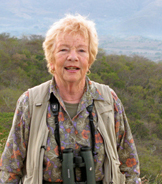
    Celebrity Birders John and Victoria Carley

  • Ron Tozer

    Ron Tozer is a charter member of OFO and one of Ontario’s best known field ornithologists. Many of Canada’s prominent scientists and conservationists benefited from Ron’s mentoring when they were summer naturalists in Algonquin Park. OFO members appreciate Ron’s depth of ornithological knowledge and his willingness to impart it to others on field trips and in his articles in Ontario Birds and OFO News.

    Ron’s impact on ornithology in Ontario is broad. Jon Dunn considers Ron’s 1974 book, co-authored with Jim Richards, Birds of the Oshawa-Lake Scugog Region, Ontario, as one of the finest regional bird books in North America. Ron is currently writing the Birds of Algonquin Park.

    Ron was co-editor of Ontario Birds for 16 years from 1991 to 2006 as it evolved into one of North America’s leading ornithological journals. He currently serves on the Ontario Bird Records Committee and was Chair for five of his 14 years on the OBRC.

    Ron participated in both Ontario Breeding Bird Atlases as Algonquin’s Regional Co-ordinator and was scientific editor of 26 species accounts in the second atlas. Birders eagerly await his Birds of Algonquin Park.


    Ron Tozer (left) receiving the 2009 Distinguished Ornithologist Award from former president Margaret Bain at the OFO Annual Convention at Point Pelee on 3 October 2009. Photo: Jean Iron

  • 2009 Certificates

    Paul and Sue Chapman

    for welcoming all birders to their home in St. Catharines (more than 100) to see the adult White‐winged Dove that was there from 21 July 2008 to at least 15 October 2008.

    Dave and Mary Elder

    for showing birders the Rainy River area and its unique birds for 25 years.

    Judith King

    for her many years of contributing to the birds and birding community of Ontario.

    Mike Pickup

    for his many years of contributing to the birds and birding community of Ontario.

    John Smith

    for his assistance to birders looking at the Orillia Northern Hawk Owl.

  • The Grippers: Pete and Rob Read and Ian and Gavin Platt

    Held 6:45 pm Friday, 16 May to 6:45 pm Saturday, 17 May, 2008

    We were very honoured to be selected the OFO Celebrity team for the Baillie Birdathon, and determined to raise lots of money. Our plan was to start in Middlesex County, on Friday evening, where we had knowledge of nesting species. There were ideal conditions, a wonderfully calm, sunny evening. We started at 6:45 pm near the London airport where Ian had scouted some areas. A number of wet spots held ducks and shorebirds and we made the rounds of the nesting raptors: Osprey, Bald Eagle, Cooper’s Hawk, Peregrines and Merlin.

    Being successful, we headed out to Komoka Provincial Park, where we knew a number of species could be located in a variety of habitats. Grasshopper Sparrow and other field species as well as ducks and shorebirds were found. Amazingly we got 12 Whimbrel there, and picked up 3 Ring-necked Duck and luckily saw a Common Nighthawk.

    Our next stop was the Delaware Sportsman’s Pond (a.k.a. “Anhinga Marsh”), which disappointed this year as only Sora was obtained for the list. After an unsuccessful hunt for owls, due to the noisy Delaware Speedway, we turned in for a quick sleep.

    The following morning we were on the road by 5:00 am, with a successful stop for Eastern Screech-Owl and getting a bonus Whip-poor-will. The morning started rather clear and not too windy, but a noticeable change was occurring and our attempts at Great Horned Owl were fruitless. It was overcast and windy by the time we got to Skunk’s Misery, our potentially make-or-break location, and we became concerned. Seeking out the more sheltered locations, which unfortunately also held hordes of mosquitoes, we picked up the usual species, including Hooded and Cerulean Warblers, Acadian Flycatcher and Pileated Woodpecker. We were pleasantly surprised by getting Broad-winged Hawk and a female Hooded Merganser. Alas, not too many migrants were located so we headed to Rondeau.

    We had ended up with 104 species before we left Middlesex County. Along the way, we stopped at various habitats known to us, and picked up a few species, notably Greater Scaup in a small farm pond beside the road. As we traveled down to the lakeshore from Morpeth we picked up a few lake birds including Common Loon, Red-breasted Merganser, and several gull species.

    We had hoped that there would be lots of migrants in Rondeau, but it didn’t pan out that way. We did pick up lots of species, mainly because we were lucky with a glorious pocket of warblers near the Maintenance Buildings which included an Orange-crowned Warbler and several Wilson’s Warblers. We also got a Yellow-breasted Chat near the Pony Barns, thanks to several local birders. While looking for the Yellow-breasted Chat, we got a pair of Tufted Titmice, and at the feeders at the Visitor’s Centre a couple of Pine Pine Siskins were grubbing. Unfortunately we “dipped out” on Prothonotary Warblers, and the Worm-eating Warbler that were said to be around. So with the wind swirling, we headed out of Rondeau to try other spots. As tradition dictated, as we left, we managed to each down a quadruple-scoop tub of ice cream from our favourite spot.

    We worked our way over to Erieau and there we picked up Black-bellied Plover, Dunlin and Ruddy Turnstones, which were numerous in the fields. In fact, large flights of those species were coming across the lake from the south. Only common species of gulls at the harbour produced nothing new, so we headed up to the Blenheim Sewage Lagoons. We were seven species richer in waterfowl when we left there which included a Bufflehead and Horned Grebe.

    We found a number of species at the Hillman Shorebird Habitat, thanks to the large group of birders there who helped us out; thanks everyone! We were standing there in short sleeves, as it was sunny and fairly warm, though there was a breeze. Unfortunately, the Mottled Duck wasn’t there at the time, nor did we encounter the King Rail from over on the road, but we got Willet, Little Gull, and Wilson’s Phalarope among others. Many shorebirds were noted coming in from off the lake. At one point it was quite an exciting sight to see all the clouds of shorebirds scared up by a passing Peregrine.

    After gleaning information about Point Pelee from the birders we encountered, as well as reading the Pelee Ontbirds Report on our PDA, we decided to make only a short visit there because we had already observed most of the species being reported there and as it was getting on in the day, we thought it would be more profitable to head north to investigate two more marshes. We birded Sanctuary area only. Then off we went.

    North of Tilbury is a marsh which you can look at through a fence, and we could see Common Moorhen, but the wind was blowing a gale, we had to bundle up again, and scopes were not able to be used. It soon rained, so we gave up and headed north to Angler Line marshes. Stocking up on gas and supplies, we drove through sun, wind and rain on the way there, watching a beautiful rainbow, and odd cloud formations, wondering if this weather would end our luck. No sooner had we arrived but the Yellow-headed Blackbird called and flew about. The sun had burst out and the winds were light here, so we also heard Least Bittern. Then, just down from that location we saw a Green Heron. Just as time was running out at 6:43 pm, I walked over to a ditch along the road, and a Black-crowned Night-Heron flew up and we watched it fly over to settle into the marsh, our last bird, the 172nd species in our odyssey. After about 18 hours of birding and travelling over 450 km we were pretty exhausted.

    We were pleased with this total, which on such a “weather day” with relatively few migrants being seen, seemed even more satisfying. We even were able to get 23 warbler species, including goodies as mentioned, but missing Black-throated Blue and Cape May – yikes.

    We really enjoyed our father-son outing while raising money for the OFO and BSC. Again, we thank OFO for allowing us to represent them in the Baillie Birdathon this year and a huge thank you to all the birders who helped us along the way and to the many who sponsored us with their pledges for OFO and BSC.

    Good birding!

    Pete Read for the Grippers: Gavin, Rob, Ian & Pete


    Bird List

    alt text

    Celebrity Birders Rob Read, Gavin Platt, Ian Platt & Pete Read – “The Grippers”

  • Harry Lumsden

    Harry Lumsden has been active for almost 60 years in the study and conservation of Ontario’s birds. He is respected worldwide as an authority on waterfowl and gallinaceous birds. He was one of the pioneers of ornithological research in northern Ontario. His research made very important additions to our knowledge on birds in that part of the province, as reflected in his numerous publications.

    As a biologist and research scientist with the Ontario Ministry of Natural Resources (MNR), Harry conducted field work and made important contributions to the birdlife of Ontario. For example, he studied Sharp-tailed Grouse and Greater Prairie-Chickens on Manitoulin Island. He retired in 1988, but continued research projects such as his work on Trumpeter Swans.

    Harry has been a member of OFO since 1983. He is a long time supporter of the organization, and has always responded enthusiastically to OFO members and editors seeking his advice. Harry has contributed articles to Ontario Birds, and for OFO’s special publication, Ornithology in Ontario. Harry Lumsden was appointed a Member of the Order of Canada in 2004 in recognition of his outstanding contributions to wildlife management and conservation.


    Harry Lumsden (right) receiving the 2008 Distinguished Ornithologist Award from Ken Abraham at the OFO Annual Convention in Hamilton on 4 October 2008. Photo: Eleanor Beagan

  • 2008 Certificates

    Peter Middleton

    for his contribution to the Sauble Beach Piping Plovers in 2007.

    Pam and Chris Heil

    for their hospitality to visiting birders during the appearance of a Rufous Hummingbird at their feeder, 18 November to 1 December 2007.

    Hydro 1 Perth Area

    for their care in dealing with Pileated Woodpeckers on their hydro poles.

    Roger Gifford

    for graciously inviting birders into his yard to observe rare birds at his feeders.

    Doug Woods

    for his outstanding work on the development of the new OFO Web Site.

    Valerie Jacobs

    for her outstanding work on the development of the new OFO Web Site

    Reta Hall

    for her efforts and generosity in accommodating OFO members in viewing the Sharp‐tailed Grouse on their lek.

    Robbie Colwell (Manager, Gore Bay-Manitoulin Airport)

    for their efforts and generosity in accommodating OFO members in viewing the Sharp‐tailed Grouse on their lek.

    Gore Bay-Manitoulin Airport Commission Inc. (Gore Bay-Manitoulin Airport)

    for their efforts and generosity in accommodating OFO members in viewing the Sharp‐tailed Grouse on their lek.

    Francois Riston, John Rocchi and their employees

    for welcoming birders to bird safely on their vast property at Waterdown Garden Supplies Ltd.

    Fred Zander of Zander Sod Comapny

    for two years has encouraged us to drive onto his sod farms to get closer to shorebirds and has suggested routes to take so as to avoid interfering with his work crews.

    Denis Lepage

    for his significant contribution to the Atlas of the Breeding Birds of Ontario 2001-2005.

    Don Sutherland

    for his significant contribution to the Atlas of the Breeding Birds of Ontario 2001-2005.

    Gregor Beck

    for his significant contribution to the Atlas of the Breeding Birds of Ontario 2001-2005.

    Andrew Couturier

    for his significant contribution to the Atlas of the Breeding Birds of Ontario 2001-2005.

    Mayor Cal Patterson and the Town Council of Wasaga Beach

    for their strong support of the Piping Plovers at Wasaga Beach.

    John Fisher and the staff of Wasaga Beach Provincial Park

    for their important efforts on behalf of the Piping Plovers at Wasaga Beach.

  • Ben and Cheryl Edgecombe

    **Friday 18 May 2007. **

    Ben and I were honoured to be named OFO celebrity birders in 2007. We decided to do our Baillie Birdathon in the Hamilton Study Area, an area we knew well and where we knew we could find a diverse number of birds in the diverse number of habitats that we are fortunate to have here in the 40 km circle based around Dundurn Castle.

    We awoke at 1:50 a.m., keen and excited to start the day. Ben and I along with our awesome team of Rob Dobos, Dave Don and Thomas Crooks embarked on our big day around 2:20 a.m. The temperature hovered at a brisk 1ºC but the winds were calm as we started out at Kerncliffe Park where we easily got Sora and Virginia Rail.

    Our route was planned out by Rob Dobos as we had completed a Hamilton Big Day a couple of years ago with the same routing and it seemed to be the best way of maximizing our species coverage. Of course the day before, a male Kentucky Warbler was found on the Northshore Trails at the RBG Arboretum so there was a little tweaking to the route at the last minute.

    We cruised through Flamborough and were delighted to hear Whip-poor-will calling even though it was chilly. One of the highlights for Ben was in Hyde Tract located on Safari Road just east of Kirkwall Road. A male Scarlet Tanager was perched at the top of an evergreen in the sunlight, brilliant colours of red and black and a lifer for Ben. Many of the birds we saw here were perched high trying to soak up the sun and get some warmth. We should have done the same.

    We covered many areas through the day, Mountsberg Conservation Area, Valens Conservation Area and along Lennon Road (a unique habitat of northern forest giving us species such as Canada, Black-and-white and Nashville Warblers on territory, Winter Wren and White-throated Sparrows singing everywhere). The Beverly Swamp was alive with Northern Waterthrush, Alder Flycatcher and a fly-by of Green Heron. The Dundas Valley, a vast expanse of many habitats was a good place to locate Louisiana Waterthrush but Lou wasn’t singing for us that day so we dipped on this species.

    The afternoon was spent at many of the great migrant traps along the lakeshore. Unfortunately many of the migrant warblers from the day before had cleared out. We were not able to get the Kentucky Warbler but ended up with 21 species of warbler. Shoreacres, Shell Park, Burloak Woods were all combed for migrants and we were able to pick up a number of species here. At Bronte Harbour was a bonus, a lingering Bonaparte’s Gull.

    Perhaps our biggest misses were ducks. You would think that given we live in the wintering duck capital of Canada that you would be able to find at least one of a number of species of ducks and scoters. Resident Red-necked Grebes, many Long-tailed Ducks and Red-breasted Mergansers comprised the majority of our species with a sprinkling of White-winged Scoter, Ruddy Duck, both scaups and a Northern Pintail.

    Later in the afternoon, we hit Fifty Point Conservation Area and Grimsby Sewage Lagoons. Highlights here at Fifty Point included more migrant warblers and Orchard Oriole, probably one of the only places locally to find these birds. Grimsby Sewage Lagoons were quiet since they had just mowed the north cell, scaring most of the remaining waterfowl which were there the day before. Perhaps I should ask the Department of National Defense to sponsor the birds they flushed.

    On to Saltfleet, an area on the escarpment up Fifty Road and west to 10th Road East. Two pairs of Upland Sandpipers, a singing Vesper Sparrow and a calling Ring-necked Pheasant added to our total as the sun went down. Then, a mad dash to Binbrook Conservation Area where a previous scouting trip had found an Osprey on nest. Thank goodness for floodlights.

    Our total ended up at 143 species. Nineteen hours of birding, total exhaustion but total exhilaration. We were very pleased with our outcome. There always are big misses on big days but the fun, the great birds, the many lifers for Ben and most of all great friends made for an excellent Baillie Birdathon.

    Thank you to all the sponsors who supported Ben and me for our birdathon. We truly enjoyed being the celebrities and raising money for the great work that the OFO does. To my best friends, Rob, Dave and Tom, a big thank you for your support, for the laughs, for the birds and most of all for the friendship. We couldn’t have done it without you.Good birding!

    Cheryl & Ben Edgecombe


    Bird List

    alt text

    Celebrity birders Ben and Cheryl Edgecombe.

    alt text

    The birding team: Rob Dobos, Dave Don and Thomas Crooks with Ben and Cheryl.

  • Mike Cadman

    Mike Cadman has been a life-long student of birds. He received his Master of Science degree from the University of Toronto in 1980 based on studies of the American Oystercatcher.

    He is a Songbird Biologist with Ontario Region of the Canadian Wildlife Service. He is best known as the driving force behind the first and now the second Ontario Breeding Bird Atlas, both monumental projects. The new atlas was published in fall 2007.

    Mike Cadman takes a lead role in many important survey programs designed to monitor Ontario’s bird populations including the Forest Bird Monitoring program, 1992 to present. Mike is active on committees and organizations devoted to the conservation of birds and their habitats such as the Society of Canadian Ornithologists and Birds Studies Canada. He was chair of the Eastern Loggerhead Shrike Recovery Team from 1992-1999.

    Mike has been studying birds for over 35 years. He has authored and co-authored many publications in both peer-reviewed and popular publications. Mike has published many articles in Ontario Birds and OFO News.


    Mike Cadman (right) receives the 2007 Distinguished Ornithologist Award from Mark Peck at the OFO Annual Convention at Point Pelee on 13 October 2007. Photo: Jean Iron

  • 2007 Certificates

    Gwen and Milton Mowbray

    in recognition of their dedication to nature and especially for protecting wildlife at their pond.

    Mike and Nancy Furber

    for welcoming birders to their property to see the Western Kingbird which was there on 26 and 27 September 2006.

    John Zehethofer

    in recognition of his freely giving his time and expertise to redesign the OFO website look in 2006.

    Essex Regional Conservation Authority

    for recognizing the importance of habitat creation for migrating shorebirds as well as enhancing viewing opportunities for visiting birders at Hillman Marsh.

    Stan Long

    for bringing Reesor Pond to the attention of the birding community in 2006.

    Ron and Lynda Valentine

    for participating in ten years of birdathons for OFO.

    Ron and Lynda Valentine.
    Photo: Jean Iron

    Township of Alfred and Plantagenet,
    Mayor Jean-Yves Lalonde

    for promoting birding in the Alfred area through the creation of the Alfred Birding Trail and particularly the Birding Tower at the Alfred Sewage Lagoon.

    Prescott-Russel Stewardship, Suzanne Lafrance

    for promoting birding in the Alfred area through the creation of the Alfred Birding Trail and particularly the Birding Tower at the Alfred Sewage Lagoon.

    Werner Schmalz, Kindermann Canada Inc.

    in recognition of his long standing support of Ontario Birds and OFO.

    Mike Malone, Pelee Wings Nature Store

    in recognition of his long standing support of Ontario Birds and OFO.

    Mike Malone.
    Photo: Jean Iron

    Paul Grant, Vortex Canada

    in recognition of his long standing support of Ontario Birds and OFO.

    Nikon Canada Inc.

    in recognition of their long standing support of Ontario Birds and OFO.

    George Madsen and Mosaic Esterhazy Holdings

    for providing access to their settling lagoons.

    Cheryl Edgecombe

    for her weekly Hamilton Naturalists Club Birding report on Ontbirds.

    Cheryl Edgecombe.
    Photo: Jean Iron

    Phyllis E.Bray

    for the many years she operated her wonderful bird feeders in Chippewa.

    Keith Lee

    for his kindness in accommodating birders wishing access to the Brighton Wetland.

    Barry Cherriere

    for his hard work in maintaining trails for birders in the Hamilton area.

    Barry Cherriere.
    Photo: Jean Iron

    Kevin Shackleton

    for his help in enabling us to bird the Holland Landing Lagoons.

    Brendan and Kim Toews

    in recognition of their important finding, and of their contribution to the successful nesting, of Piping Plovers at Sauble Beach in 2007.

    Brendan and Kim Loews.
    Photo: Jean Iron

    Cindy Cartwright, Stewart Nut, Peter Siebbert, Kirk Silver, Bruce Birding Club, Friends of Sauble Beach, Sauble Cottagers Association, Municipality of South Bruce Peninsula, Owen Sound Field Naturalists

    in recognition of their contribution to the successful nesting, of Piping Plovers at Sauble Beach in 2007.

    Cindy Cartwright.
    Photo: Jean Iron

    Jeff Robinson, Barbara Sleza of the Canadian Wildlife Service (Environment Canada)

    in recognition of their important contribution to the successful nesting of Piping Plovers at Sauble Beach in 2007.

    Mark Shoreman, Madeline Austen, Kevin Hawthorne,
    Leo Heyens of the Ontario Ministry of Natural Resources

    in recognition of their important contribution to the successful nesting of Piping Plovers at Sauble Beach in 2007.

    Todd Kish of Environment Canada

    in recognition of his important contribution to the successful nesting of Piping Plovers at Sauble Beach in 2007.

    Jack Dingledine of the United States Fish and Wildlife Service

    in recognition of his important contribution to the successful nesting of Piping Plovers at Sauble Beach in 2007.

  • Dave Milsom

    24 May on a clear evening we left Toronto and headed west. Chris Escott was driving. Chester Gryski, Bob Falconer and I were the passengers. All four are members of the OFO Board of Directors.

    Our first of several anxious moments came when we were detoured around Caledonia because of a blockade but we were blessed with a very interesting and eye-opening drive though the vast Six Nations Reserve. None of us had ever been there before–we were most impressed by its size as well as the pride taken in their community by the residents.

    Reaching Long Point at 10 pm, we headed to the sand road running along the northern edge of St. Williams Forestry Station. Bets were placed on our \“first bird\”–Great Horned Owl (2 choices) could not be heard, nor was Barred Owl responding to the tape. The other choice, Whip-poor-will, was the first bird encountered just as we reached a sandy clearing.

    Off to Big Creek Marsh along the Causeway, where we added several good finds as we staggered along in the dark on the uneven trail. Least Bittern called repeatedly. American Coot, Common Moorhen, Canada Goose, Marsh Wren and an unexpected Sedge Wren all sang or called.

    The marsh off Concession A was next. An Eastern Screech-Owl was heard, as was a male Ring-necked Pheasant, Virginia Rail and Sora Rail. Even a Swamp Sparrow sang in the dark. Nearby, we heard Gray Catbird and American Robin vocalizing.

    Further owl attempts near Backus Woods and the Wilson Tract proved fruitless. Dawn mercifully arrived as we stood in the Rowanwood Sanctuary and listened to a cacophony of dawn chorus as the sun rose. I was pleased to be with three such expert birders who were all adept at recognizing each individual song in the midst of so many. I usually need to concentrate very hard to hear just one tune when maybe eight are playing at the same time!

    We were doing well until this unknown tune had us all baffled. Not only that, but the darn singer would not allow itself to be recognized. After “wasting” over five minutes at the best time of the day, we finally caught a glimpse of a Blue-winged Warbler. To infuriate us further, he now began singing his regular song!

    Totally without sleep, I occasionally heard a familiar song, such as that of an American Goldfinch, and my mind was blank for a few seconds. But once the dawn chorus had subsided, we were able to concentrate on individuals much better and our list continued to grow. The Wilson Tract provided us an opportunity to check out the size and ferocity of the 2006 mosquito crop. Well-prepared, we were not unduly hampered in our search through here for rare warblers but the Hooded eluded us. Suddenly Chris whispered, “hear that!” We stopped and the distinctive sound of a Worm-eating Warbler came though the undergrowth. Using his I-pod, Chris brought it within a few feet of us, but typical of this species it did not want to show. We were sure of its identity so continued on.

    Time was going fast by now (almost 7:30am) and we wanted to visit the park and the Old Cut Banding Station early, so we left Walsingham and headed into Long Point Provincial Park. One of my favourite stands of pine and several adjacent clearings deep into the park were visited first. As usual on a good migration day, this area was very productive: several warblers, vireos and flycatchers were seen well. Across the road, two Sandhill Cranes flew over the marsh. An American Bittern called. A quick check of the west beach produced no shorebirds of note, so we sped off to Old Cut. Here Stuart Mackenzie and the team were most helpful. Did we need a Philadelphia Vireo? Yes. And we were quickly directed to the bird. The same for Bay-breasted Warbler and Red-breasted Nuthatch.

    We headed back up the Causeway and stopped to view Big Creek in the daylight. A totally different experience, as we added several new birds not heard at night – Mute Swan (not surprising!), Black Tern, Pied-billed Grebe etc. We dropped Bob at a restaurant to get some breakfast while the three of us ate our snacks and scoped the Bird Studies Canada pond. Good mudflats here resulted in Short-billed Dowitcher, sandpipers, plovers and Dunlin being seen. Returning to pick up Bob, we learned he had been waiting outside five minutes watching a Downy Woodpecker. No big deal, I thought, we’ll get one later. We never did!

    Another fine wet spot was at the bridge on Concession 1, where Lesser Yellowlegs and a few ducks were added. Then to Backus Woods for another mosquito encounter. They weren’t too bad, but the trail was disappointing. No Yellow-bellied Sapsucker or Pileated Woodpecker as I’d had a few days earlier with my British group. We heard Cerulean Warbler, Scarlet Tanager, saw a Blackburnian Warbler well, but no Yellow-throated Vireo. On return to the van, Chris drove in on the other side of the big pond. We were quickly rewarded when a male Prothonotary Warbler sang in full view. We heard an Acadian Flycatcher sing once nearby, but were so intent on calling in the Vireo that we forgot about it until the end of the count. Several attempts at Yellow-throated Vireo only brought in more Red-eyed Vireos, so we finally departed for ¼ Line East.

    The single male Prairie Warbler sang from the exact same tree as I’d seen it three days earlier. We then drove behind the trout pond at the St. Williams Forestry Station. We searched here for boreal species, but could not find Winter Wren or Brown Creeper. However, a Blue-headed Vireo was a good find. Even better was a male Hooded Warbler, then a surprising second Worm-eating Warbler singing in the undergrowth.

    We were doing quite satisfactorily but I was frequently nodding off for two-minute naps as Chris drove from one location to another.

    We now decided to search for species not yet found but definitely attainable if we went to the right place. For example, we needed Cliff Swallow so we drove to the bridge in Port Royal and immediately found one. The Yellow-breasted Chat I’d found while relieving myself a few days earlier could not be relocated but we always found something new when we visited such good sites.

    The afternoon was coming to an end when we decided to journey through Turkey Point to Normandale and Fishers Glen. Frequent stops at the fish hatchery, feeders, beach and marina were generally unproductive and time was becoming an enemy!

    On such a birding big-day, you have to be prepared to alter your plan when you examine the time remaining vis-à-vis the species still missing. It was about 6:30 pm when I suggested we go straight to Townsend Lagoons and then drive to Hamilton for the last 30 minutes or so of daylight.

    This plan proved very worthwhile. At Townsend, we immediately scoped across the first lagoon a Red-necked Phalarope. Sanding next to it was a Curlew Sandpiper! We knew this bird had been at Townsend but consensus was that it had departed several days earlier. We added a couple of ducks and even a late Tundra Swan here too.

    At 7:30 pm we drove off for Hamilton. It was risky but we decided to go via Caledonia along Highway 6. Fortunately, we were not held up and arrived on Eastport with over 40 minutes of daylight left. Double-crested Cormorant, Caspian Tern, Black-crowned Night-Heron and Gadwall were quickly added. The Peregrine Falcon was at the lift bridge, Lesser Scaup swam in Windermere. At 9 pm we stood on the Lake Ontario shoreline at Van Wagners Beach. Only Mallards and Cormorants were flying by. It seemed to be over. I asked a passer-by to take a photo of our weary but contented band. He obliged. We were examining the picture when Chris suddenly called out, “Black-bellied Plover flying towards the beach.” We stopped in amazement as a single plover dropped onto the beach directly in front of us. I started laughing at our good fortune so hard that the bird flew off again almost immediately. But it was a great way to end what had been a memorable day!

    Our total of 156 species was not a record, although it tied the second highest total for OFO in the past decade, but it exceeded by six our hoped-for number.

    We worked very well as a team and never argued despite our lack of sleep Chris was a stalwart. He drove throughout and his expertise was invaluable. Chester and Bob were both brilliant too. Their skills and sharp eyes contributed greatly to our final total.

    Many, many thanks to all those who so kindly sponsored me on this 2006 Baillie Birdathon. I hope you will all agree from this report that it was worth it.It certainly was much fun to participate in such a worthwhile cause.


    Bird List

    alt text

    Dave Milsom.

    alt text

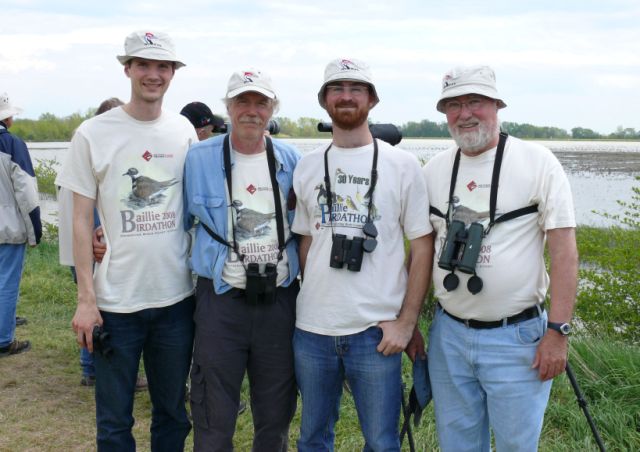
    Chester Gryski, Bob Falconer, Dave Milsom and Chris Escott.