Blog

  • 2019 Certificates

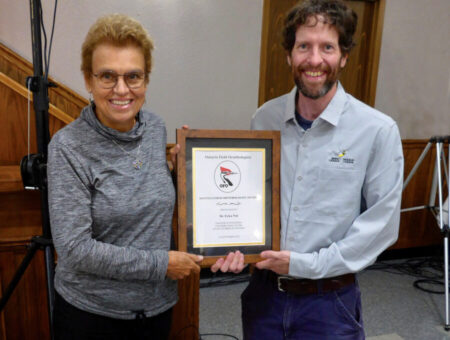
    Linda Johnston and her support team Deborah Johnston, David Lavigne, and Liz Black-Petrie

    For permitting the birding community access to see the Calliope Hummingbird and for providing exemplary hospitality.

    Glenn Coady

    For coordinating the viewing of the Calliope Hummingbird in Goderich with the homeowner and providing information to the birding community via Ontbirds.

    Peninsula Field Naturalists, Jean Hampson, Bob Highcock, Carol Horvat, and Doug Gillard

    For leading the Niagara Hotspot Hike at last minute notice the day of the Gull Workshop in 2018.

    Benjamin Oldfield

    For his dedication to building, placing and maintaining nest boxes for Tree Swallows and Eastern Bluebirds, which repopulated those species in the area.

  • Tom Hince, Paul Pratt and Bruce Di Labio

    OFO’s Celebrity Birders Big Sit Birdathon Summary 2019

    By Bruce Di Labio

    Tom Hince, Paul Pratt, and I had lots of fun on our second annual Big Sit fundraiser for the Ontario Field Ornithologists May 11, 2019. We used the same location as last year, west side of the tip of Point Pelee National Park. Park staff (especially Sarah Rupert) kindly allowed early access to the Tip and were very supportive. Many friends dropped by through the day offering support and even adding a bird or two to the list.

    Unlike last year’s unsettled weather it was a beautiful sunny day. Not the best for an exciting birding day. Kathi Cavanaugh Hince brought us hot coffee and snacks plus enough food for an army! Greatly appreciated by the team. Jeremy Bensette made sure we didn’t miss anything!

    Our final total was 108 species. Last year we recorded 110 species. The top bird was a Yellow-billed Cuckoo which landed briefly in a tree beside the van.

    Thanks to all those who have contributed to this Bird Studies Canada and OFO fundraiser. There is lots of time to make a contribution at https://www.birdscanada.org/birdathon (search for “OFO Celebrity Birders” under “Find a team or Person”).

    Thank you, Tom, Paul and Bruce


  • Margaret Bain

    Margaret Jean Christine Bain came to what was seen around the world as a very desirable Canada, flush with promise and optimism in the immediate aftermath of hosting the world at the very successful Expo ’67, and one still freshly caught up in the excitement of ‘Trudeau-mania’. She was part of the tail end of the great post-war British ‘brain drain’ that was to see many highly educated and adventurous ex-patriots seek out opportunities spanning across the globe.

    As with Charles Fothergill, William Pope, Thomas McIlwraith, William Loane and William Brodie in previous eras of immigration in the 19th century, the loss to the British Isles was to prove to be a source of great benefit to ornithology in Ontario.

    From an early age, Margaret was clearly set on a course of achievement and pushing through established ‘glass ceilings’. Between 1956 and 1961 she studied medicine on scholarship at the University of Edinburgh in Scotland, and after residency in London hospitals she specialized in obstetrics. By the end of the decade she had emigrated to Canada, where she initially worked in Toronto in the country’s two busiest obstetrical departments at Women’s College Hospital and Mount Sinai Hospital. In 1971, she moved to Durham Region to raise her family and begin a private practice in obstetrics and accepted a staff position in the obstetrical department at Oshawa General Hospital, where over the next two-and-a-half decades she would rise through the ranks to become Chief of the Department of Obstetrics and Gynecology, and eventually Vice-Chair of the hospital’s entire Department of Surgery.

    One day in the early 1970s, an initial lifelong casual interest in birds was to provide one of those pivotal ‘spark moments’ that most birders can instantly relate to, and it was to transform the remainder of Margaret’s life. During the peak of spring migration, she went out into her garden at 210 Byron Street North in Whitby to find a very heavy grounding of warblers and other passerines literally filling every tree and bush with a blaze of colour and activity. She was stricken with awe at the wonder and joy of bird migration and soon joined the local natural history club, the Oshawa Naturalists (later the Durham Region Field Naturalists), where she met many fine early mentors like Murray and Doris Speirs, Edge and Betty Pegg, George Scott, Naomi Le Vay, Ron Tozer, Jim Richards, Dennis Barry and Dave Calvert. She soon learned all the wonderful birding hotspots available in Durham and dove into learning and mastering Ontario’s birds and in no time at all there was no stopping her. Despite a very demanding career and a young family, she seemed to effortlessly be everywhere and always in tune with where the birding was the most productive. It was not very long before she was regularly turning up rare birds and she was soon considered one of the leading local birders in Durham, and inevitably in Ontario as a whole.

    This brings me to the dilemma I first considered when I proposed Margaret for the Distinguished Ornithologist Award. I knew that all of the longtime OFO members and birders in Ontario were well acquainted with Margaret, but I was trying to figure out a way make her relatable to the young generation of new birders, many of whom would not be familiar with her history. After thinking about it for some time, I think I found the perfect way to make her experience relatable to this new generation. It was crystallized in a simple analogy — Margaret Bain was Jean Iron before Jean Iron was Jean Iron! Judging by the response that line got at the OFO banquet where I presented Margaret with the Distinguished Ornithologist Award, I believe it achieved the desired effect.

    Much like Clarence Decatur Howe, the war-time Liberal government Cabinet minister who worked on so many important files that he was nicknamed the ‘Minister of Everything’, Margaret soon had her finger in so many pies that in retrospect it is very hard to believe it left much time for either birding or delivering babies!

    In 1980, she took over summarizing the monthly notable bird sightings in the newsletter of the Durham Region Field Naturalists, a task which she continued to perform for more than two decades. One of the most interesting records for which she had uncovered the details and found material evidence was the sighting by two non-birders of Ontario’s first ever Black Skimmer at Whitby Harbour in the fall of 1977. She also served on the Durham Region Field Naturalists’ executive for many years, culminating in service as its President and past President.

    During the first Ontario Breeding Bird Atlas from 1981 to 1985, she stepped in to serve as Regional Coordinator for Durham Region and recruited and organized atlassers and a series of square bashes to ensure that all of the region’s squares achieved the desired coverage targets. During the second Ontario Breeding Bird Atlas, from 2001 to 2005, she served as Regional Coordinator for Northumberland County.

    One of the most celebrated parts of her legacy involved a conservation initiative forced on her by events. In the inaugural issue of OFO’s journal, Ontario Birds, Margaret wrote the first OFO birding site guide to one of her most cherished Durham Region birding sites, Whitby’s Thickson’s Woods, which she brought to the popular consciousness of the entire Ontario birding community as one of the finest bird migration traps on the north shore of Lake Ontario. Many did not realize, however, how close this site had recently come to being lost forever.

    In 1982, the developer who owned the woods, frustrated by an inability to obtain permits to develop the site for lucrative condominiums, decided to sell the logging rights to the two hundred year-old eastern white pines. Work crews came in and felled 66 of the old growth pines from the woods before much could be done to stop them. Local birders and the residents of the Thickson Point community were dismayed with the pace of the destruction of this vital migratory bird stopover, and receiving little help in effectively thwarting this via government agencies, had to spring into action and come up with their own solution.

    Into the breach stepped Margaret Bain and a group of other influential birders and local residents. After literally standing in the way of the chainsaws in protest and employing cheque-book bribes to send work crews away without felling any trees, they bought the time to organize that solution. In addition to frustrating the developer, Margaret had the time to organize the Thickson’s Woods Heritage Trust, a land trust which would serve as the model by which she and a few key supporters could make a serious effort to outright negotiate an offer to purchase the woods from the developer. In dipping into her children’s education funds and convincing other friends to make similar large donations to the cause, they were able to come up with a down payment on that purchase and to secure a mortgage for the balance of the funding. Disaster was averted and by 1984 it was clear that the woods had been saved. Margaret went on to become the long-time Chair of the Thickson’s Woods Land Trust and served on its Board of Directors for more than twenty-five years, during which time countless successful donor campaigns, bake sales, wildlife art auctions and fall fairs were organized to see to it that the mortgages on the woods, as well as the addition of the adjacent meadow and a couple of privately held woodlots, were all duly paid off, thus saving the resultant Thickson’s Wood Nature Reserve in perpetuity.

    On 13 April 1985, Margaret discovered a new bird species for Ontario a little north of the woods on Thickson Road South when she found a Eurasian Jackdaw on a hydro pole near the railway line. This record was accepted by the Ontario Bird Records Committee and she documented the occurrence in a paper in Ontario Birds.

    Perhaps Margaret’s greatest contribution to ornithology in Ontario has been her trailblazing ways and her stellar example as a role model for other women in birding and ornithology. In 1982, she became only the fourth female member of the formerly all-male Toronto Ornithological Club (after Phyllis MacKay, Joy Goodwin and Linda Weseloh were accepted as members in 1980). In 1988, she became the first female President of the Ontario Field Ornithologists. The rapid succession of successful and effective female presidents in Margaret Bain, Gerry Shemilt and Jean Iron, during OFO’s greatest period of growth, definitely had a transformative effect on the role of women in field ornithology in Ontario. Talented female birders like Mary Gartshore, Sarah Rupert, Barbara Charlton, Cheryl Edgecombe, Seabrooke Leckie, Sarah Lamond and Amanda Guercio now garner a respect from their male counterparts that was reflexively denied to an earlier generation like Margaret Mitchell, Doris Speirs, Naomi Le Vay and Phyllis MacKay.

    Continuing on the same theme, Margaret was elected as the first female voting member of the Ontario Bird Records Committee and served as both Secretary and Chair in her time on the committee. She has also served OFO as an editorial assistant for Ontario Birds in the past.

    Between 1990 and 1994, she teamed with Brian Henshaw to produce a series of excellent annual Durham Region Bird Reports summarizing the years 1989 through 1993 in the region.

    Between 1991 and 2004, she teamed with Phill Holder as the co-founder and co-editor of the magazine Birders Journal, a highly respected print journal that had many exceptional articles on identification and status of birds, and she co-wrote a Cross-Canada Roundup each issue, first with Matt Holder and then with Don Shanahan. In November 2000, Birders Journal sponsored and organized a hugely successful North American Gull Conference at Niagara Falls that was attended by birders from all across North America.

    As if this wasn’t enough to fill her time, Margaret also served terms as Chair of the Board of the Long Point Bird Observatory and as a board member of the American Birding Association. For many years beginning in 2000, she wrote the fall seasonal summary for the Ontario Region in the journal North American Birds.

    In starting a draft manuscript on the Birds of the Greater Toronto Area, it quickly became obvious to me that Margaret was involved in so many of the significant bird records in Durham Region over the past 45 years, that an important consideration in staving off carpal tunnel syndrome for me, was to create a hot-key shortcut on the keyboard, so as not to have to type out her name so frequently!

    Durham Region has been blessed over the years with an abundance of excellent leaders in ornithology: Charles Fothergill, George Gwynne Bird, Earl Calvert, Albert Ellis Allin, Doris and Murray Speirs, Betty and Edge Pegg, Naomi and Bert Le Vay, George Scott, Alf Bunker, Ron Tozer, Jim Richards, Dennis Barry, Ross James, Rob Nisbet, Jim Mountjoy and James Kamstra, to name but a few. All of them have one thing in common — none are any more distinguished than Margaret.

    Although she has moved to Cobourg and now shares her brand of magic in Northumberland County, rest assured that many of us will always view her as the ‘Grand Dame’ of Durham birding.

    Congratulations on a long overdue honour Margaret!


    Margaret Bain at the Point Pelee National Park Visitor Centre on 14 May 2007. Photo: Jean Iron

  • Bruce Di Labio, Paul Pratt and Tom Hince

    Hello Ontbirders,

    Wondering how we did? Tom Hince, Paul Pratt, and myself just wrapped up our Big Sit fundraiser for the Ontario Field Orthithologists. We picked a spot on the west side of the Tip of Point Pelee National Park. Park staff (especially Sarah Rupert) kindly allowed early access to the Tip and were very supportive. Many friends dropped by through the day offering support and even adding a bird or two to the list. The weather was a challenge but we sheltered under the tailgate of the van when the rains came and Kathi Cavanaugh Hince brought us hot coffee and a hot lunch to keep us going. Michael A. Biro brought some hot potatoes and a gnatcatcher. Mike Runtz snagged the only Bay-breasted Warbler of the day. The top birds were a heard only Smith’s Longspur (rattle call), six Red-throated Loons, 20 species of warblers, and all three scoters. Big misses were American Crow, Chimney Swift and Red-bellied Woodpecker. And drum roll please. The grand total was 110 species smashing the previous Pelee Big Sit record!

    Thanks to all those who contributed to the OFO fundraiser.

    It was fantastic for us to do a big day together after almost seventeen years (since breaking the North American big day record!).

    Thank you,

    Tom, Paul and Bruce


  • Alan Wormington

    Introduction

    It was my great honour to present the 2018 Distinguished Ornithologist Award (DOA) posthumously to Alan Wormington at the Annual General Meeting of the Ontario Field Ornithologists (OFO) in Leamington on 29 September 2018. Although I dearly wished he could have been there to accept it in person, I am sure almost all of you know that he died a little over two years ago of cancer at the age of 62.

    Alan was, simply put, one of the finest birders in Ontario and for that matter all of North America (Figure 1). He combined skilled field identification of birds with research and writing as few birders have ever done. Upon Alan’s death, Jim Richards of Orono, Ontario, himself a Distinguished Ornithologist Award recipient, remarked that Ontario ornithology had lost its single most important figure since James L. Baillie died in 1970. I could not have said it better. Alan’s birding skills were renowned across the continent. As an example, I remember one amusing anecdote from about 20 years ago when a visiting American birder, obviously a novice and obviously mis-hearing the name “Worm-eating Warbler”, was impressed that Alan had a warbler named after him. I also remember Alan saying to me several years ago that he was better than anyone else in Ontario at spotting and identifying birds (Figure 2). This sounds like boasting but Alan was matter of fact about his skills; he was simply making an assessment. He also stated his hearing was second to none in the province for bird identification — although he did mention a couple of other birders who could keep up with him in this regard.

    Normally in these DOA articles for Ontario Birds, a detailed account of that person’s accomplishments follows. However, for Alan this was essentially done shortly after his death on 3 September 2016. There was a tribute piece to Alan in Ontario Birds (Lamond 2016a), another one in Ontario Insects (Lamond 2016b), two tribute articles in the Wood Duck (Curry 2016, Lamond 2016c), an extended article on Alan in the Windsor Star (Sacheli 2016), a lengthy obituary in The Globe and Mail (MacKay 2016) and another obituary in the National Post and the Hamilton Spectator (Anonymous 2016). Nonetheless, I will highlight some of Alan’s most noted accomplishments below.

    The Early Years

    Alan Wormington was born in west Hamilton, Ontario, on 20 June 1954. His first love was butterflies and he amassed quite a collection at a tender age. Of course, those were different times from today and Alan remembered his mother dropping him off in the “wilds” of rural Ancaster to pursue butterflies when he was only 12 years old. A friend of Alan’s sister remembers that his bedroom was an absolute disaster, covered in butterfly boards and books. Alan wrote his first article when he was 16, entitled “Butterflies of the Hamilton area and other interesting areas” (Wormington 1970) which was published in the Wood Duck, the journal of the Hamilton Naturalists’ Club.

    It was soon after this that he got into birds. Alan, as a young teenager, was able to explore the nearby Cootes Paradise daily. In fact, he birded so much that it was interfering with his schooling and by Grade 10 he was a major-league truant. Alan and his parents were summoned to the principal’s office at Westdale High School where he was told in no uncertain terms that if he did not shape up he would be expelled. Alan vividly remembers how upset his parents were when he exclaimed, “I can live with that.” Well, it was not long after that that his wish came true as he never did complete Grade 10.

    Even at the age of 15, Alan was a formidable bird finder. For example, on 6 May 1970 at Cootes Paradise, Alan showed several long-time birders their first Hamilton area Summer Tanager (Piranga rubra). Alan was largely self-taught although he did go birding quite a bit with very talented birders in his early years such as Alf Epp and then later with George North and Bob Curry. According to Bob, “Alan was a wunderkind who almost immediately could find more birds and better birds than any of us.” As an example, he found Hamilton’s second record of Kirtland’s Warbler (Setophaga kirtlandii) on 1 September 1969 at Cootes Paradise. At the time, no one believed Alan about this incredible sighting and dismissed it. Alan went back to the same location the next day and saw the bird again. But still, no one believed him until later when people realized how talented he was, and although it sounds like a hyperbole, his talent became legendary in Ontario. For example, most of us would consider ourselves exceptionally fortunate to add one new bird species to the Ontario checklist. Alan added seven: Fish Crow (Corvus ossifragus) (James 1983), Royal Tern (Thalasseus maximus) (James 1984), Cave Swallow (Petrochelidon fulva) (Wormington and Curry 1990), Plumbeous Vireo (Vireo plumbeus) (Dobos 1998), Lesser Nighthawk (Chordeiles acutipennis) (Roy 2002), Sooty/ Short-tailed Shearwater (Puffinus griseus/ tenuirostris) (Wormington and Cranford 2011) and Kelp Gull (Larus dominicanus) (Burrell and Charlton 2016). Of course, he also found so many other rare birds, as designated by the Ontario Bird Records Committee.

    Documenting and Publishing

    You do not get the Distinguished Ornithologist Award by just being a birder, even an exceptionally gifted one. There was much more to Alan than just watching birds. He was a well-published author with dozens of notes and articles on birds, this despite not finishing Grade 10! His first ornithological publication was entitled “The big May day” (Wormington 1976). More articles followed such as “Nesting of Acadian Flycatcher in Hamilton” (Wormington 1977), “Concentrations of migrant diving ducks at Point Pelee National Park, Ontario in response to invasion of Zebra Mussels” (Wormington and Leach 1992), “The status and distribution of Mississippi Kite in Ontario” (Wormington 1993), “Point Pelee Little Gull banded in Finland!” (Wormington 2001a); “Brown Pelicans on the Great Lakes” (Wormington 2003), and “Historical overview, seasonal timing and abundance of Bonaparte’s Gull at Point Pelee” (Wormington 2013). For several years, Alan was also the compiler for the Ontario spring seasonal summary in North American Birds (e.g., Wormington 2010) and he was tireless in his desire to get this as comprehensive and correct as it could be.

    In the “In Memoriam” article in Ontario Birds (Lamond 2016a), I listed 48 publications in the selected bibliography that he authored or co-authored; the majority of these he wrote as the sole author.

    The most important of Alan’s traits was, I think, his hunger to meticulously record all bird records, be that at Hamilton, Point Pelee or anywhere in Ontario. When Alan was documenting a record it had to be complete and correct. He had to know who found the bird, the exact location, the first date and the last date and the observers had to be listed accurately. For example, it would not be correct to list me as Bill Lamond, it had to be William G. Lamond, or it had to be Robert Z. Dobos or Robert H. Curry or Kevin A. McLaughlin, which was ironic as Alan never used his own full name. He used just “Alan Wormington” but the name on his birth certificate is “Laurie Alan Wormington.” Alan completely ignored the Laurie part of his name for his whole adult life.

    A Legacy of Initiatives

    Alan also started things; he initiated significant projects, many of which still operate. For instance, at the age of 20, in 1974, he started the Hamilton Fall Bird Count, a count which is going stronger than it has ever been with upwards of 140 participants annually. This bird census, which was renamed the Alan Wormington Fall Bird Count in his honour following his death, has amassed an incredible amount of data on the migration of birds through the Hamilton area in the first week of November. These data were of great importance for many species accounts in Bob Curry’s Birds of Hamilton (Curry and the Hamilton Naturalists’ Club 2006).

    Alan started the Point Pelee Annual Spring Migration report (Wormington 1978a) which was published by the Park until 1987; he continued producing the report privately until 2015 (G. Coady pers. comm.). Another contribution was that in 1978, Alan began a sixteen month stint of writing a weekly birding column in The Globe and Mail newspaper (e.g., Wormington 1978b, 1979) which Peter Whelan had initiated the year prior and which Alan assumed until Peter resumed writing it in late 1979. The column ran until shortly before Peter’s death in August 1999.

    Alan also got people birding into new areas of the province. He was a pioneer in the pursuit of migrants along the north shore of Lake Superior and the south end of James Bay. He understood that these areas concentrated migrants, including vagrants. One only needs to look at some of his publications to see how successful this search for vagrants was: “Fall Vagrancy of the Indigo Bunting in Northern Ontario” (Wormington 1986); “White-eyed Vireo: New to Northern Ontario” (Wormington 1987a); “Orchard Oriole: New to Northern Ontario” (Wormington and Lamond 1987); and “Inca Dove: New to Ontario and Canada” (Graham and Wormington 1993). Alan promoted the Moosonee area on southern James Bay as a great place to bird and he also repeatedly visited Netitishi Point (Figure 3) in southern James Bay beginning in the 1980s. Many vagrants have been recorded at Netitishi by Alan and others such as Sooty/ Short-tailed Shearwater (Wormington and Cranford 2011), Dovekie (Alle alle) (Wormington and Cranford 2011), Northern Fulmar (Fulmarus glacialis) (Cranford 2013) and Western Kingbird (Tyrannus verticalis) (Burrell and Charlton 2016), to name but a few. Alan, along with a few other keen birders, started the Ontario Bird Records Committee in 1982. He served on this committee for 19 years and for six years he wrote or coauthored the OBRC annual report (e.g., Wormington 1987b). I remember that Alan was so meticulous with having the report correct, that before sending it out for review, he would introduce six errors into the report and exhort the reviewers to find the six errors. In this manner, he assumed they would also find errors that he had overlooked, all in an intense desire to produce a flawless report. Alan also started a natural history publication about Point Pelee entitled Point Pelee Natural History News (e.g., Wormington 2001b). This was an excellent publication that was packed full of pure natural history articles. Alas, the publication only lasted three years and Alan gave it upasitwasjusttoomuchworktodoby himself.

    Point Pelee: Alan’s Special Place

    Despite these many contributions to the ornithology of Ontario, Alan will be known by most as Mr. Point Pelee. He would have hated this term but Alan was synonymous with Point Pelee. He moved there permanently in 1979 and lived in the same residence just north of the park for over 35 years. During that period, no one spent the amount of time birding at the park that Alan did; not even close. He was a fixture at the “Tip” on good migration days whether it be the spring, summer, fall or winter. Alan amassed an incredible amount of data on the birdlife in the park beginning with the aforementioned seasonal summaries. He maintained the park checklists for several years and he had files for every species that had occurred at Point Pelee. He added to these files whenever a notable record came to light. Of course, this was all in preparation for his eventual book, Birds of Point Pelee. Alan wrote accounts for every species that had ever occurred at Point Pelee. The knowledge of ornithology in Ontario is diminished in that he did not finish this book after he became ill as I am convinced it would have been an excellent book—as good as or better than any regional bird book that has been published and on such an important birding area in North America. No one knows why he did not get it finished. I have to assume that he thought he had more time to live after his initial cancer diagnosis. When we tried to encourage him to work on the book, he always demurred— “there’s lots of time for that” he would say.

    When his illness progressed markedly in the summer of 2016, he finally took action. He formed a publications committee committee of Bob Curry, Glenn Coady and Phil Holder; he and they were to have their first meeting in October 2016. Of course, that first meeting never happened. After Alan’s death the publication committee endeavoured to see his project through to the book stage. However, although there is a manuscript, it cannot be published in its current form. It is hoped that funding can be made available such that a suitable person can bring this book, this life’s work, to fruition.

    Conclusion

    Some readers may wonder why Alan had not been offered the Distinguished Ornithologist Award before he died. Truth be told, it was, twice, but Alan refused it both times. I would not say it was modesty that prevented Alan from accepting this award. Not at all. Alan was actually a rather shy person. He was not an introvert but he was not outgoing and he shunned crowds to a large degree. I think he likely refused because he just was not a fan of this type of award. Perhaps he thought they were frivolous and he would not take part. It is hard to know for certain. One could ask if it is proper to bestow this award on him in death when he refused to accept it in life. I can never know for sure, but I think he would be fine with getting this award now. I can more or less hear him say, “Yeah, go ahead. Now’s a good time.”

    At the OFO meeting, Sarah Rupert, a fellow OFO birder, and a good friend of Alan’s and an employee of Parks Canada at Point Pelee National Park, accepted the Distinguished Ornithologist Award on Alan’s behalf. Alan is survived by his sister Janne Hackl and nephew Jonathan. Although it would have been proper for Janne to accept the award, she realized that its proper place to be displayed was at Point Pelee and she agreed that Parks Canada should be the keeper of the award on Alan’s behalf. The Distinguished Ornithologist Award plaque is to be mounted in the Point Pelee Visitor Centre, which will include an interpretive panel reflecting Alan Wormington’s place in Ontario ornithology and his contributions to Point Pelee National Park with the likes of Jack Miner, William Saunders and Percy Taverner. A fitting tribute indeed.


    Alan at the Tip of Point Pelee on 12 May 2016. Photo: Jean Iron

  • 2018 Certificates

    Mark Peck

    For his many years serving as a resources person for the editors of Ontario Birds, for leading OFO hikes and for his many years of service to OFO and members as the ROM liaison person on the OBRC.

    Ron Tozer

    For his continued dedication to birding and birders and for leading many OFO hikes in the past in Algonquin P.P., and Niagara, as well as his contributions to Ontario Birds as a past editor and contributor, and for his service on various OFO committees (OBRC), and for his MC work at OFO Conventions. Ron has been and continues to be an integral part of OFO.

    FLAP Canada

    FLAP Canada, a registered Canadian charity, is widely recognized as the pre-eminent authority on the bird-building collision issue. For almost 25 yearsFLAP Canada and a network of over 70 partners, thousands of supporters and many other nature organizations, are devoted to keeping birds safe for the benefit of nature and people.

    Fred Helleiner

    For his many years of service reporting bird sightings on ONTBirds which greatly benefited the birding community.

  • Jeremy Bensette, Dan Riley and Josh Vandermeulen

    Jeremy, Dan and I planned to complete our Birdathon within the confines of the Point Pelee Birding Area on May 13, 2017. Compared to Big Day attempts elsewhere in the province, Point Pelee Big Days are highly dependent on the local conditions, in particular the variety of migrant species that happen to be in the area on a given day. While Big Days completed in central and eastern Ontario can rely on a good diversity of breeding species, especially if one is not limited to a small geographic area, the success of a Point Pelee Big Day is based almost exclusively on the selection of migrant species that one catches up with. During some days it may be possible to see 160+ species while during other days 110 may even be a difficult number to reach. Dan, Jeremy and I all happened to be in the Point Pelee area from May 12-15, and after some scouting on May 12 we determined that May 13 would be the day of our attempt. Theoretically, this date is near the peak of bird migration with a nice selection of both earlier and later migrants.

    We were up by 4:30 and as we stepped outside the neighbourhood was already alive with the familiar song of several American Robins, our first bird of the day. We motored out of Leamington towards Hillman Marsh where we hoped to pick up a few marsh birds before heading into the park. A quick stop at the Leamington Airport provided a few Horned Larks and Savannah Sparrows, singing away while the sky was still mostly black. These species can be notoriously difficult at times within the Point Pelee Birding Area.

    We only spent a few minutes at Hillman Marsh as dawn was approaching. Rails remained quiet or at least had their voiced drowned out by the hoardes of blackbirds, but we did have a Hooded Merganser fly over us here, our only one of the day.

    New birds were quickly added as we entered Point Pelee National Park and by the time we reached the Marsh Boardwalk we were near 40 species. Walking around the boardwalk was quite productive – a Marsh Wren rattled away, several Wood Ducks flew over, but best of all was a great look at a flyby American Bittern while a second “blonk-a-donk”ed from somewhere out in the marsh.

    We made our way towards the Tip, adding numerous warblers and other species as the forest awoke. It was apparent that a few new birds had arrived overnight including good numbers of the early-ish warblers such as Nashville Warbler, Common Yellowthroat, Black-and-white Warbler and Northern Parula, but the conditions were not ideal and many of the later migrants had yet to appear. As we were birding among the crowds in the woods near the Tip we spotted a White-eyed Vireo at eye-level, which had somehow gone undetected by the crowd until that point! We completed a brief vigil at the very Tip, scoping the waters for gulls and ducks while occasional orioles (and not much else) flew off the Tip. A Bobolink suddenly appeared in a Hackberry at the Tip, while a Tufted Titmouse also alighted on the same tree a few times throughout our Tip watch. Tufted Titmouse is quite unusual within the Point Pelee Birding Area, so it immediately became a candidate for Bird of the Day. We scoped a few Greater Scaup and a female Bufflehead off of the Tip, the four “expected” species of gulls, and both Common Loon and Horned Grebe. We were in decent shape with our day list quickly approaching 80.

    The rest of the morning consisted of wandering trails throughout the southern half of the park. Our warbler tally hit 20 by late morning, though we only added a few more in the afternoon to bring us to 22 species on the day. Notable misses included a few of the earlier migrants (Pine, Blue-winged) and several of the later species (Blackpoll, Mourning, Canada, Wilson’s). Speaking of warblers, we spent 30 minutes with the Prothonotary Warblers on the Woodland Nature Trail; perhaps not the best strategy on a Big Day, but it was hard to tear ourselves away from the “Swamp Candles”!

    Tilden’s Woods was probably the most productive area though it was the busiest I had ever seen it with birders and photographers! The tall trees in the sloughs provided a Golden-winged Warbler and our only Cape May, Orange-crowned and Bay-breasted Warblers on the day. A bright Acadian Flycatcher was associating with a Least Flycatcher at the Shuster/Tilden’s intersection, though we couldn’t catch up with the Hairy Woodpecker that several birding parties had noted in Tilden’s Woods previously.

    As the afternoon wore on our energy and motivation levels began to wane somewhat, and we spent too much time socializing with all of the familiar faces we came across. But we continued to slowly add new birds, such as Lincoln’s Sparrow, Scarlet Tanager, Winter Wren (a nice surprise so late into the season), and Ruby-throated Hummingbird. Try as we might, we couldn’t pull out an Indigo Bunting or Swainson’s Thrush, however!

    By 5:00 PM we were finally ready to leave the park. Our list was over 110 species and 130 still remained a possibility. We scored a couple of Ring-necked Pheasants at a typical location in the Onion Fields and by 5:30 PM began to bird Hillman Marsh. An American Woodcock with several fuzzy, super cute babies had been spotted in the grasses near the parking lot; a nice addition to our Birdathon and saving us a stop later in the evening. At the shorebird cell we quickly added the expected ducks – Gadwall, American Wigeon, Northern Shoveler, Green-winged Teal and Lesser Scaup – though Blue-winged Teal, Ring-necked Duck and Ruddy Duck were nowhere to be found. Other than a few Dunlins, shorebirds were also almost non-existent and our ambition of reaching 130 species was quickly fading. We made the decision to walk along the dyke towards the southwest corner of the shorebird cell and here we lucked out, adding Pectoral Sandpiper, Least Sandpiper, Semipalmated Sandpiper and Short-billed Dowitcher in quick succession. Both Greater and Lesser Yellowlegs were nowhere to be found and the same could be said for Ruddy Turnstone, Willet, Semipalmated Plover and several other hoped-for shorebirds. We lucked out with a few Forster’s Terns and a single Black Tern in the main part of the marsh – those would have been embarrassing misses! By 7:15 PM we had wrapped up at Hillman Marsh, with 126 species to our name.

    At this point Dan and I called it a day as there were very few possibilities left to get, but Jeremy continued until dark. Thanks to his efforts, four new species were added to the day list – Solitary Sandpiper, Semipalmated Plover, Swainson’s Thrush, and Eastern Whip-poor-will.

    When it was all said and done we had tallied 130 species. It was a number that was a little less than what we had hoped for, but considering the modest diversity present that day we were quite happy with our final count. For those wondering, some of our big misses for the day included Red-tailed Hawk, Indigo Bunting, Ruddy Duck and Blue-winged Teal. Can’t get them all!

    We would like to thank everyone who sponsored us on our Birdathon!

    Good birding! Josh, Dan and Jeremy


    alt text

    Celebrity Birders 2017 Dan Riley, Josh Vandermeulen and Jeremy Bensette.

  • Dan Strickland

    Dan Strickland received the Ontario Field Ornithologists’ (OFO) Distinguished Ornithologist Award for 2017. It was my honour and pleasure to present this award to Dan, my long-time friend and Algonquin Provincial Park colleague, during the OFO Convention at Long Point in September. His outstanding record of scientific research on the Gray Jay (Perisorius canadensis) and his long and accomplished career in communicating Algonquin Park’s natural history make him a very worthy recipient of this award.

    Dan was born in Toronto in 1942 and moved to Burlington when he was four years old. His birding skills developed as a member of the Juniors in the Hamilton Naturalists’ Club during the late 1950s. Dan recalls finding a Razorbill (Alca torda) with Red-necked Grebes (Podiceps grisigrena) off Brant Street in Burlington on 31 May 1957 when he was just fifteen years old. He also remembers his relief and satisfaction when George North, the Dean of Hamilton birders, later came to view the bird through his old telescope and pronounced that it was indeed a Razorbill.

    He first worked as a seasonal park naturalist in 1960, in Quetico Provincial Park. Dan became a summer naturalist in Algonquin Provincial Park in 1965. He was the Chief Park Naturalist in Algonquin by 1970, a post which he held for thirty years until his retirement in 2000. Dan mentored many seasonal naturalists over the years who went on to distinguished careers involving the environment. In one of his greatest accomplishments, Dan was responsible for the overall concept, site, story line, exhibit planning and writing for the Algonquin Park Visitor Centre, a 26,000-square foot, diorama-based natural and human history museum opened in 1993 to celebrate Algonquin Park’s centenary.

    Dan has been recognized for his park naturalist work through the presentation of a number of awards. In 1976, he received the Richards Education Award from the Federation of Ontario Naturalists (now Ontario Nature) for work in Algonquin Park promoting greater public understanding and appreciation of Ontario’s natural history and resources. Dan was given the Amethyst Award (for “outstanding achievement by Ontario Public Servants”) “in recognition of (his) professional work to make Algonquin Park an educational natural attraction and a model for other parks in Canada.”

    In 1999, the Shan Walshe Award was presented to him for “excellence in interpretation in Ontario’s Provincial Parks.” In that same year, he was given the MNR Excellence in Leadership Award for “outstanding dedication and commitment to the ongoing recovery of Ontario’s Peregrine Falcon population” in recognition of his contributions to the reintroduction program in Algonquin from 1977 to 1986. Dan received the Federal Provincial Parks Council Merit Award for “Meritorious Service to Canadian Parks” in 2000.

    Seasonal naturalist Russ Rutter began colour-banding Gray Jays in Algonquin Park during 1964, starting one of the world’s longest-running studies of an individually marked bird population (54 years, from 1964 to 2017, and counting). Rutter’s research inspired Dan to undertake his own Gray Jay study in Quebec during the late 1960s, for which he earned a Master’s Degree in 1969 from the University of Montreal. After Russ’s death in 1976, Dan took over and expanded the Algonquin Park Gray Jay study. More than 1500 birds have been colour-banded and over 950 nests have been found during this research. Dan’s Gray Jay study has revealed significant features of its life history. For example, partial dispersal of juveniles occurs in June. The dominant juvenile (usually a male) drives its siblings away from the parental territory. This behaviour reflects the limitation of a territory to support Gray Jays through the long winter. Adults actively prevent the surviving juvenile on their territory from helping feed nestlings, but allow the juvenile to feed the young after they leave the nest. This behaviour probably helps reduce the attraction of land-based predators (such as Red Squirrels) to the nest. Finally, Gray Jays survive up to six months of boreal winter by living off food they have stored during late summer and fall. Climate change (especially winter thaws) is apparently causing the rotting of stored food and a decline in the Gray Jay population at the southern edge of its Ontario range, including along the Highway 60 Corridor of Algonquin Park. As of 2014, only 19 (44%) of 43 Gray Jay territories occupied in 1970 were still active in the Corridor. Occupied territories had extensive conifers, especially black spruce. Formerly occupied mixed conifer-hardwood forest territories were vacant by 2014. Dan’s research showed that stored food survived longer and retained more food value when placed against the bark of black spruce and other conifers, indicating the anti-bacterial effect of exposure to the resin of these trees.

    Dan Strickland is the recognized world authority on the Gray Jay. He wrote the Gray Jay species accounts in both of the Ontario Breeding Bird Atlases and in the Quebec atlas. In 1993, Dan and coauthor Henri Ouellet wrote the Gray Jay account in The Birds of North America, and Dan updated and revised the account in the online version in 2011. Based on his study of the Gray Jay, he has authored or coauthored 22 peer-reviewed research papers. From 1974 to 2009 (36 years), Dan wrote 34 popular books and 368 articles in The Raven (Park newsletter) about Algonquin’s natural and cultural heritage, including birds. He has authored five articles in Ontario Birds. The most recent was a detailed account of why there was no valid taxonomic or nomenclatural reason for the American Ornithologists’ Union to have changed the name Canada Jay to Gray Jay.

    Dan has studied jays far beyond Algonquin Park since his retirement. In 2001, he was invited to assist in field work on the rare Sichuan Jay (Perisoreus internigrans), sponsored by the Chinese Government. Dan conducted research during the fall of 2001 and the spring and fall of 2002 on Anticosti Island in the Gulf of Saint Lawrence to assess Gray Jay nesting behaviour there in the absence of Red Squirrels. At 75 years of age, Dan has now launched a new Gray Jay research project in Strathcona Provincial Park on Vancouver Island in British Columbia, involving Perisoreus canadensis obscurus/griseus subspecies. These Gray Jays have notably different appearance, genetics, behaviour and social organization than the boreal/eastern subspecies (P. c. canadensis) which occurs here in Ontario. Dan believes there may be sufficient evidence to support these western jays being restored to their former status as a distinct species, P. obscurus, separate from P. canadensis.

    After reading this brief overview concerning some of Dan Strickland’s accomplishments, I am confident you will agree that he is indeed an outstanding recipient of the Distinguished Ornithologist Award.


    Ron Tozer (left) presents OFO’s Distinguished Ornithologist Award for 2017 to Dan Strickland. Photo: Jean Iron

  • 2017 Certificates

    Anouk Hoedeman

    For co-founding Safe Wings Ottawa in 2013 and for her tireless efforts to reduce bird mortality from window collisions through research, rescue, and education.

    Brian Ratcliff

    For keeping track of rare bird records and assisting the OBRC for the northwestern Ontario region.

    Mark Peck

    For his many years in assisting the OBRC as ROM liaison and for providing expert opinion on records reviewed by the OBRC.

    Margaret Bain

    For compiling and organizing the Ontario section of North American Birds over the past decade.

    Heidi Staniforth and Kelly Moore, operators of the Tern In B&B

    For hosting and welcoming birders wishing to view a White-winged Dove at their property in May 2017.

    Mike Malone and Joan Walker of Pelee Wings and Mike Wales

    For generously welcoming and allowing access to birders wishing to view the Magnificent Frigatebird in July 2017, near Point Pelee National Park.

    Lisa Bildy

    For her extensive contribution to the OFO Young Birders camp.

    Jeff and Angela Skevington

    For volunteering as camp counsellors during the OFO Young Birders camp.

    Don Kennedy

    For his outstanding volunteerism and coordination of efforts to assist the nesting Piping Plovers at Sauble Beach over the last 11 years.

  • Bruce and Ben Di Labio

    Hi Everyone

    Over the decades I’ve done many “big days” starting in the mid 1970s on my bicycle and into the 1990s and early 2000s on competitive big days at the World Series of Birding, Texas Birding Classic and Taverner Cup. I thought I had seen all the possible weather conditions. Not so.

    I’ve dealt with rain and wind but heat was something I didn’t count on.

    Ben and I started at midnight east of Ottawa and it was a slow start with very little calling and no nocturnal call notes overhead. It was obvious the late date and recent heat wave would make it more challenging. Regardless, our spirits were high and we worked our way towards Algonquin Park hoping to arrive by dawn. On Friday I had my car in for an oil change and check up. Everything was a go, at least I thought. As we staring working our way towards Algonquin it became obvious that one of my front wheel bearings was going. There was a sound which continued to increase in volume as the day progressed. Despite this problem we continued on. Over the years of big day competitions I knew that once you are committed to a route you don’t change the route. If you do it becomes a long chase. As we changed drivers Ben did the Algonquin run. We made numerous stops and were rewarded with few birds. During the night we managed to add American Woodcock, Sora , Virginia Rail, Eastern Screech-Owl, Barred Owl, and lots of Whip-poor-wills. At Algonquin Park we covered a variety of areas including Arowhon Road, Wolf Howl Pond, Spruce Bog Boardwalk and Opeongo Lake Road. Overall we did well with a number of species including Olive-sided Flycatcher, Boreal Chickadee, numerous warblers and an over abundance of black flies and mosquitos! The walk along the old railway line to Wolf Howl Pond and West Rose Lake was not enjoyable. Though birds were singing/active we missed a number of the Algonquin Park specialties including Spruce Grouse, Black-backed Woodpecker, and Gray Jay. We left Algonquin Park by 8:30am and made our way towards Presqu’ile Provincial Park. This leg of the journey is usually three hours with a few stops. As Ben and I worked our way south the temperature started to rise and few birds were singing. Our highlight was the Madoc Sewage Lagoon where we found 2 Trumpeter Swan, a family of Hooded Mergansers, along with Green-winged Teal and a few shorebirds. With the rising temperature we made a brief stop in Brighton Hills at noon and added Blue-winged Warbler, along with Eastern Towhee, Field Sparrow and Rose-breasted Grosbeak. We heard a Golden-winged Warbler calling too, which turned out to be a hybrid, Brewster’s Warbler.

    Our next stop was Presqu’ile Provincial Park where we added a few waterbirds and Piping Plover. Unfortunately due to the hot weather the beach was busy and few shorebirds were present. At 1:15pm we were on our way to the Napanee area in search of Loggerhead Shrike and any other grassland species. After a while we finally got one Loggerhead Shrike, one Upland Sandpiper and American Kestrel as the temperature reached 35c! By 4:30pm we reached the Opinicon Road/Chaffeys Lock area. It was deadly quiet with only a few Red-eyed Vireos and Indigo Buntings singing. We couldn’t find any of the area specialities. Over the next few hours we made our way to the Carp area and finished along the Carp river at Ben’s favorite birding spot, the site of last years Little Egret. With water levels low there was only one shorebird, a breeding plumage Black-bellied Plover along with Northern Rough-winged Swallows. Our final new species for the day was Chimney Swift which was guaranteed since they breed in our chimney. It was a long but fun day. We ended with 132 species and travelled 850 kms from midnight to 7:00pm.

    Ben and I would like to thank everyone who sponsored us for the 2016 Birdathon. If you haven’t had a chance to donate there is still time.


    Bird List

    alt text

    Celebrity Birders 2016